
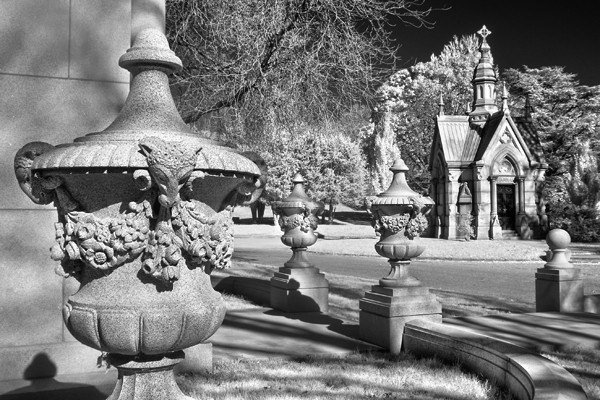
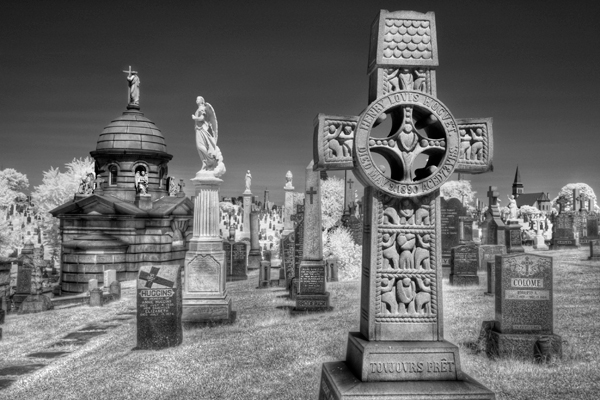
As spring advances and trees and grass begin to green up, I start thinking about shooting infrared images.The green foliage turns white in infrared, creating a very unique look. I have found that some of the Victorian era cemeteries can look quite stunning when shot in infrared, and todays post is one such example. This is Calvary cemetery outside New York City, and features very impressive statuary, monuments and carved stones. I have a black backpack and often set it down while I am shooting, and more than once I have gone into panic mode as I wander a bit and realize I forgot where I set my bag. Try finding a bag amongst thousands of dark stones and you quickly remember to wear your bag when you move around. I always go with a friend, and we usually shoot different subjects, so at least once a trip I wait till he is in deep concentration looking through the camera, and I sneak up and suddenly grab his arm or talk in his ear, and of course he returns the favor. This particular cemetery goes on for acres and includes 3 million burials.The large mausoleum on the left is that of the Johnston family. the following is from the internet about this family and where my title came from.
John Johnston died May 17, 1887, seven years after brother Charles and seventeen years before his other brother Robert A. Johnston.
John Johnston led the J. & C. Johnston company, and the J. & C. Johnston department store at Broadway and Twenty-Second Street was a popular source for dress silks and other fabrics. The store was among the most successful of its time, prospering during an era when similar companies frequently went bankrupt.The fortunes of J. & C. Johnston took a drastic turn for the worse after John Johnston’s passing. Responsibility for the company passed to Robert A. Johnston, at whose helm the business failed.
Mr. Johnston possessed millions when the business came to him through the death of his brothers, but he lost all in a few years, and in 1888 the house went out of existence. He retired to his palatial home at Mount St. Vincent, on the Hudson. Later the place was sold at foreclosure and the house burned, the owner having a narrow escape. Since then he had lived alone in a barn on the property, refusing charity. He was found sick with pneumonia and insane ten days ago.”
This obituary makes tantalizing reference to the mighty structure that has fascinated folks for years: “[Robert Johnston’s] body … will be immured in the magnificent family mausoleum built many years ago at a cost of $300,000 in Calvary Cemetery.”The dismal circumstances of Robert Johnston’s death did not cost him a space in the family mausoleum. The mausoleum’s presence today echoes the success and personal fortunes of the Johnston name while housing the man who wasted it.The story is indeed interesting, as the tomb is occupied by prince and pauper alike.


 Donald Reese Photography