The Prince and The Pauper

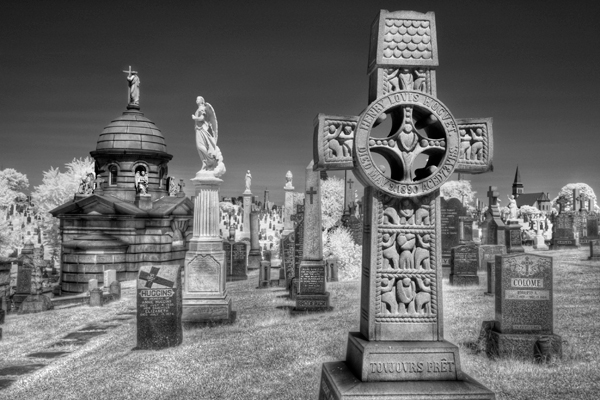
As spring advances and trees and grass begin to green up, I start thinking about shooting infrared images.The green foliage turns white in infrared, creating a very unique look. I have found that some of the Victorian era cemeteries can look quite stunning when shot in infrared, and todays post is one such example. This is Calvary cemetery outside New York City, and features very impressive statuary, monuments and carved stones. I have a black backpack and often set it down while I am shooting, and more than once I have gone into panic mode as I wander a bit and realize I forgot where I set my bag. Try finding a bag amongst thousands of dark stones and you quickly remember to wear your bag when you move around. I always go with a friend, and we usually shoot different subjects, so at least once a trip I wait till he is in deep concentration looking through the camera, and I sneak up and suddenly grab his arm or talk in his ear, and of course he returns the favor. This particular cemetery goes on for acres and includes 3 million burials.The large mausoleum on the left is that of the Johnston family. the following is from the internet about this family and where my title came from.

John Johnston died May 17, 1887, seven years after brother Charles and seventeen years before his other brother Robert A. Johnston.

John Johnston led the J. & C. Johnston company, and the J. & C. Johnston department store at Broadway and Twenty-Second Street was a popular source for dress silks and other fabrics. The store was among the most successful of its time, prospering during an era when similar companies frequently went bankrupt.The fortunes of J. & C. Johnston took a drastic turn for the worse after John Johnston’s passing. Responsibility for the company passed to Robert A. Johnston, at whose helm the business failed.

Mr. Johnston possessed millions when the business came to him through the death of his brothers, but he lost all in a few years, and in 1888 the house went out of existence. He retired to his palatial home at Mount St. Vincent, on the Hudson. Later the place was sold at foreclosure and the house burned, the owner having a narrow escape. Since then he had lived alone in a barn on the property, refusing charity. He was found sick with pneumonia and insane ten days ago.”

This obituary makes tantalizing reference to the mighty structure that has fascinated folks for years: “[Robert Johnston’s] body … will be immured in the magnificent family mausoleum built many years ago at a cost of $300,000 in Calvary Cemetery.”The dismal circumstances of Robert Johnston’s death did not cost him a space in the family mausoleum. The mausoleum’s presence today echoes the success and personal fortunes of the Johnston name while housing the man who wasted it.The story is indeed interesting, as the tomb is occupied by prince and pauper alike.

Mechanical marvel

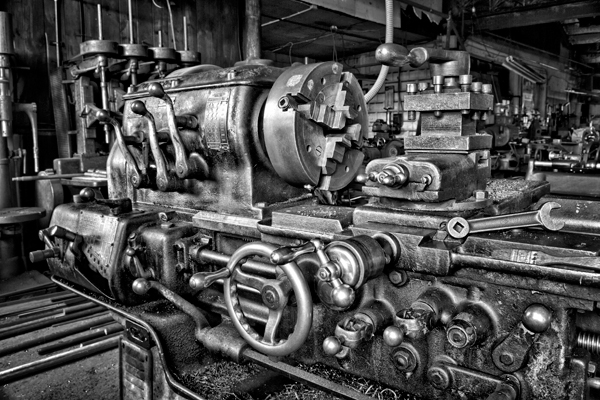
Pardon my brevity with today’s post, but I was hammered with two migraines in one day today, which is very rare for me, so as I type this, I pretty much feel like this machine is sitting on my head. Sometimes when the weather changes, These things can hit me for whatever reason. So hopefully I did not post this shot before, and my apologies if I did.

The Fairground Organ

This image hopefully showcases what I consider to be a very beautiful Bruder Fair Organ from the late 1800s. The owner was gracious enough to let me photograph the piece, which has the most lovely colors on its carved surfaces. The founder of the Waldkirch organ industry was Ignaz Bruder, 1780-1845, and he was the master teacher for several german organ builders, and four of his sons founded the business Gebruder Bruder. Two of those sons, Wilhelm and Arnold, founded their own organ factory under the name of Wilhelm Bruder Sohne. I assume this piece was done by them because that name is painted across the middle, above the figure. I did not hear the organ play,but I bet it really resonates for blocks when it does play. I am by no means an authority on these organs, but doing a little research on the net, it was hard to find two organs that looked the same, so quite possibly each piece was one of a kind. The craftsmanship is simply mind-boggling. I light painted the whole room to give it a dreamy look. Can you imagine anyone having the ability or desire to create such a masterpiece today? It not only is beautiful to look at, but the music it produces most certainly delighted countless crowds way back when as well.

Weighing the options

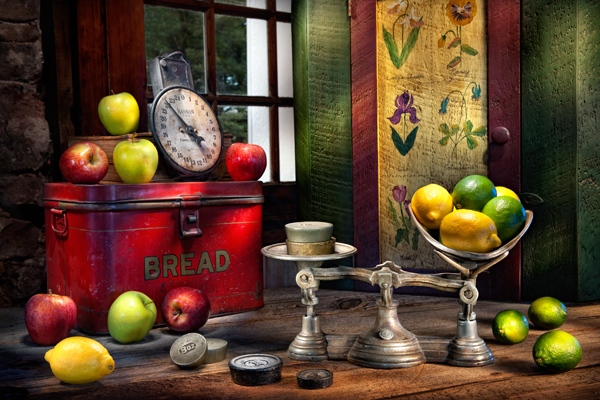
Today I visited a local florist that is planning to open an antique shop in the near future, and he graciously allowed me to look through his collection for possible photo subjects. I saw the old scale first and then selected several items to add some balance and color to the shot. I have no idea where some of my ideas come from, but I decided fruit would look neat on the scale, so I zipped over to a nearby produce stand and picked up a selection of limes,lemons and apples. For budding photographers taking notes, I light painted this shot using my small flashlight, and because the room had numerous windows, I used a 3 stop neutral density filter on the lens, which allowed me to shoot exposures around 8 seconds each. The window directly behind the shot was covered by black fabric till the very end, and then the exposure for the window portion was simply painted in on lighten mode in layers in Photoshop. Thanks to Kerry for giving me free reign in the shop.

A Stitch in Time

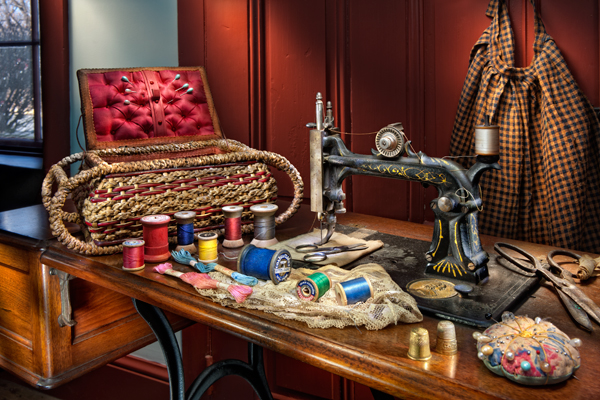
I spent the morning sunday shooting with my friend larry who is light painting master, and we each did our best to do something unique at our local historical society. I chose an old sewing machine, and friends Margi and Dan loaned me several antique sewing items to help bring the shot to life. I used small pen flashlights and my big spotlight to accent the pieces, and the shot took me nearly an hour and a half to do. The best I could figure was this sewing machine is one made by the man who got the first patent for a lock stitch design in 1846, and his name was Elias Howe. Mr Howe had to defend his patent in court from 1849-1854, because he found that Isaac Singer, and Walter Hunt had been selling a facsimile of his machine and lockstitch design. He eventually won the case and won considerable royalties from singer. I can imagine the many hands that worked diligently on this machine in the late 1800s and early 1900s, creating garments and necessities for the family. My grandmother was a great quilter and I remember her working countless hours on her old sewing machine doing patches,and a few times over the years she would relay the stories of how a needle had gone straight through her finger and nail while sewing.

The Doll Maker

For those who follow me here, and are not very familiar with me, nature and scenic photography is what most people know me for, so it is somewhat ironic that I post so many images other than that style here. I have found myself sharing things that I don’t always share in public, and I like to mix things up to keep folks interested. This shot from a local doll maker was done using a lensbaby,which creates a very specific plane of focus,depending on how you articulate the front elements. For me it was more frustrating than fun using it, so after the initial few days of trying it, it is now collecting dust. There are some neat shots on the lensbaby site, but I personally lost interest in it pretty quickly. This effect is exactly what the lens did and was not blurred after the fact. I thought this subject was a good choice to test this device out on, and I like the result on this image.

The Turret Lathe

This is another machine shop undertaking, and once again the layers of color and texture drew me to photograph it. The best I could make out was that it is a turret lathe, but don’t hold me to that. I checked in the folder I save my files in and I  had shot eleven separate files to light this as shown. Many times I will shoot triple that amount so I don’t miss any piece of the puzzle. As I have mentioned before, a sturdy tripod, a basic laptop and a few flashlights are all you need.

Working Late Tonight

Todays image is one of several from my shoot at the machine shop yesterday. This place has so much history and character in every nook and cranny, that I become overwhelmed at times trying to decide which subject to shoot. I chose what I believe to be a drill press for a shot at dusk because it was positioned right at the windows where the sunset colored the evening sky outside. The patina of oil,dirt,metal shavings and everything else provided the perfect canvas to light paint. Lee who owns the shop graciously allowed myself and a friend several hours of uninterrupted shooting, which was really appreciated. I picked the title because we started shooting around 4pm and finished at 9pm, and a worker from the day shift was still running a mill in the back room to catch up on several jobs for clients as we were heading home to bed. You couldn’t ask for a more accommodating crew than the guys who help us shoot there.

Valentine’s Day

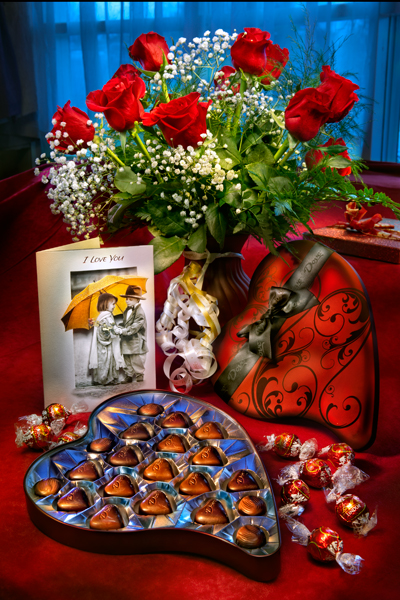
Unfortunately I have never been known as a great romantic, and these roses were something that were sitting at work recently, so they provided an inexpensive opportunity for a photo. The chocolates were bought at a local retailer to round out the theme, and now I am addicted to the Lindt Lindor chocolate truffles shown on the table. Chocolate inside chocolate should be outlawed, but hopefully I can keep my intake to one or two a day.The metal heart shaped lid proved very tricky to light correctly, and so did the candy box interior. I heard on the radio that the average man spends 180 dollars on valentines day, which amazed me for some reason.

The Old Workhorse

My photo for today features an old GMC pickup that I spotted yesterday sitting in an old abandoned car wash. Supposedly this vehicle has been parked here for years waiting for someone to restore it to its former glory.I was told the owner wants $5000 for it, so anyone reading this can contact me if you want to buy it. You can see the dust accumulated on the windshield, which is ironic considering it is parked in a car wash. I used a flashlight and some flash to light the truck body and walls of the bay area.This was shot in the dark, except for the fluorescent light, which I had no control over.

The Golden Age of Music.

Today I wanted to share a photograph I did recently showcasing a beautiful Wurlitzer 125 Military  Band Organ that dates back to the early 1900s. This amazing musical instrument is from an era when automobiles,airplanes and electric lighting were all new. Given the opportunity to photograph such a marvelous old piece, I cant help but think of the generations of people who must have had a smile on their face as they listened to this mechanical wonder. This organ would have played in a variety of locations, such as skating rinks and carousels and can supposedly really fill the air with a tune.

As an artist, I have always found music to be very inspiring, and the ability that many musicians and singers have to take you to places that let your spirit soar has always fascinated me. This old instrument undoubtedly captivated the imagination of those who heard it play as they skated or simply enjoyed special times with family and friends. Most certainly, anyone from an older generation would have fond memories come flooding back from their youth if they were to hear this classic come to life.

I must extend a very special thank you to the owner of this piece, for allowing me access to capture something so beautiful, and also the opportunity to express my creativity through my photography. Things like this are not seen every day, and it affords ones imagination an opportunity to dream of things of wonder and beauty from times past.The original catalog states it is a 44 key instrument designed for small to medium size rinks. It lists instrumentation as outside visible-13 Brass trumpets, 13 Brass Piccolos, 13 Wooden Flageolets, 2 Drums,and a Cymbal. Inside it has 5 Wooden Trombones, 5 Open Basses, 13 Open Pipes, 6 Stopped Pipes, 11 Pipes in Accompaniment. Bottom- 5 Stopped Basses, 7 Stopped Pipes, 10 Pipes in Accompaniment, 1 Stop for Trumpets, 1 Stop for Trombones, 1 Stop for Piccolos, 1 Stop for Flageolets, Bass Drum and Cymbal.After reading about all the instruments, it’s probably good I did not ask to hear it play in a closed setting. Shipping weight was noted as 800 pounds.There are also two harmonicas lying on the table to echo the whole music theme, and the one is called a Hohnerphone that utilized a small horn like amplifier. Another very cool old instrument on a smaller scale of course.

For many seeing this image may invoke visions of merry go rounds, circus midways or other childhood memories that few other automatic instruments can match. I hope anyone seeing this image enjoys it as much as I did photographing it.

The Birthday Present.

I am constantly amazed by architecture from days gone by, and I enjoy capturing locations that I find visually appealing. This home was originally commissioned by Peter Watt, co-founder of Watt and Shand department stores, and he presented it to his wife on her birthday. It was built in 1896 and remained in the family for over 70 years. As far as I know, it is currently for sale, and the last I heard, it started at 5 million, but is now listed at 3 million. If I ever hit the lottery, perhaps I will buy it. I photographed the home from the sidewalk, just outside the iron gate shown in the black and white infrared version.The cascading ivy was the perfect complement as it turned white in the infrared spectrum.I had an old Nikon D200 converted to do only infrared by the light pixel company.I was never really that dazzled by that camera,especially at any iso above 200, but it works great now for infrared.sorry to those who saw only one photo this morning.I missed the update button last night.

The Invincible Machine.

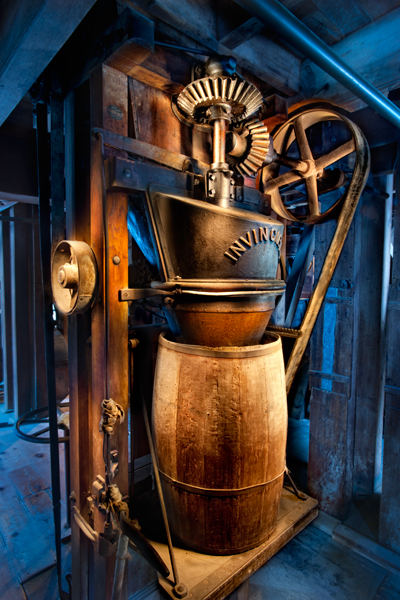
Nothing is really invincible, but this machine found in an old mill seems to be very well-built and has the name invincible on its front. A sticker on the beam says invincible cleaners, but I have no clue what it did in the mill operation. Evening light was pouring in the windows while I was lighting the gears and barrel, so we have a cold verses warm effect.This was shot in the same place as yesterdays post, and thanks to no heat inside, temperatures were near freezing, which was actually colder than it was outside. Perhaps that comes from the stream that runs under a portion of the building.

The doctor will see you now!

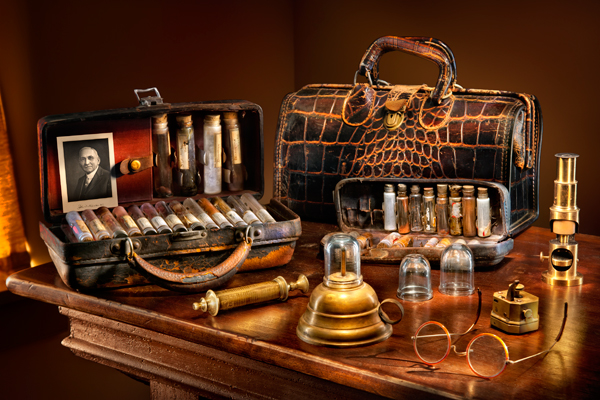
This light painting effort from my shoot today includes some of the tools doctors used in days gone by, and reminds me that I am happy to be living in modern times. This small grouping of medical items came to me courtesy of the local historical society, who I have been working closely with to highlight some of the pieces in their collection. The doctors bag is well-worn and one can only imagine the stories it has seen, while the smaller cases still hold pills that would have been prescribed at the turn of the century. The round device in the foreground was used to heat the clear glass domes which, when applied to the body would draw blood out through a vacuum effect,  curing the patient of whatever malady they had, or so they thought. The tiny metal device near the glasses would slice the skin with a series of very sharp blades. The two remaining items are what I believe are an early microscope, and a syringe.

The photograph of the doctor was added after my shoot, and was photographed in a locked display case. it was downsized from the larger photo, and I added it because I just felt its nice to see the people who made a difference in their communities and this doctor was one such person. He is Doctor John Franklin Mentzer, born in 1862, and it was said his service to the community could hardly be equaled. He was a Physician, a postmaster during President Benjamin Harrison’s term, Was director of a trolley company, and was a county treasurer as well. In 1904 and 1908, he was a county delegate to the republican national convention, which nominated Presidents Theodore Roosevelt and Howard Taft. He died in 1958 at the age of 96.

One important point for those wishing to try this type of image, is you absolutely cannot bump anything during your light painting, or you will not have registration between the various pieces. I bumped the microscope about a half hour into shooting the scene, and thankfully I had that half of the shot already captured. This technique takes a certain amount of dedication to your photography, but I thoroughly enjoy the creative process it entails.

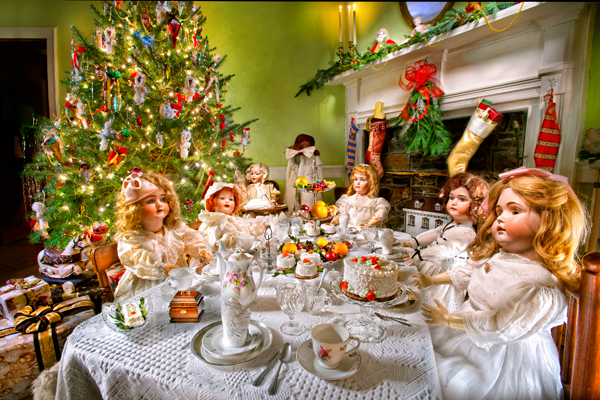
A Spot of Tea?

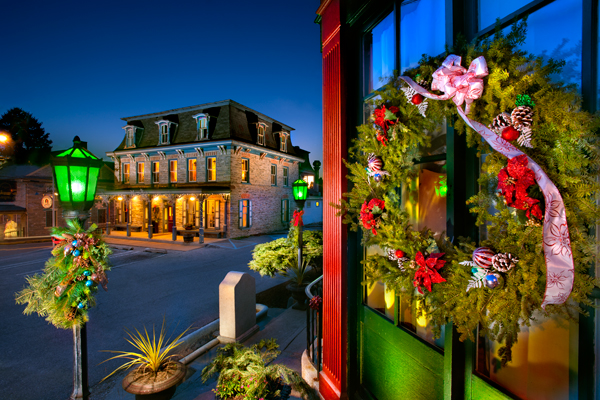
Hopefully those following my work will bear with me posting Christmas images after the fact. I hated to let them fade into oblivion without sharing them this year yet. The doll display is part of a Christmas Tree event done bi-annually at Historic Poole Forge in Lancaster County, Pa. A local Doll club does an outstanding job setting this scene up. I lit each doll separately to bring out details. The other shot is in a local town and features a tavern dating back to 1746. For those taking notes, I brought the Christmas decor from home that is hanging on the post and zip tied it to add a little extra to that area. The lamps are really green and I lit everything else. All I needed was a little snow, but this year is a real bust for snow so far. Another interesting bit of info is the fact the wreath was about 8 feet off the ground, so I used an 8 foot stepladder that I modified to accept a steel post, and that allows me to attach my camera and shoot things approaching 10 feet off the ground. I must use a laptop to fire the camera to avoid any movement on the ladder though.

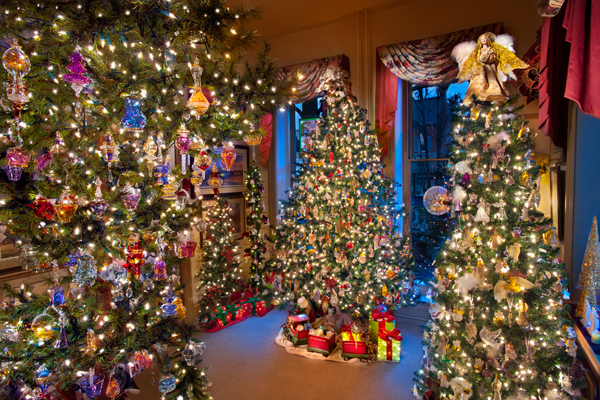
Christmas Past and Present.

Well obviously Christmas is past, but since I love all things related to Christmas, I asked permission to shoot the Christmas display at a local shop tonight. That shop, called Sheldon’s Gallery and Frame Shop, features fine art and a variety of wonderful gifts throughout the year, and the owner was gracious enough to grant me access to shoot what I consider a lovely scene. The bottom image was taken of the exterior of the neighboring building and the gallery a year or two ago, and is also quite impressive architecturally speaking. I remember the evening quite well as a snow emergency was declared, yet I decided I was going out shooting anyway. The town was absolutely silent in a blanket of white as I happily took in the still of a winter’s night.